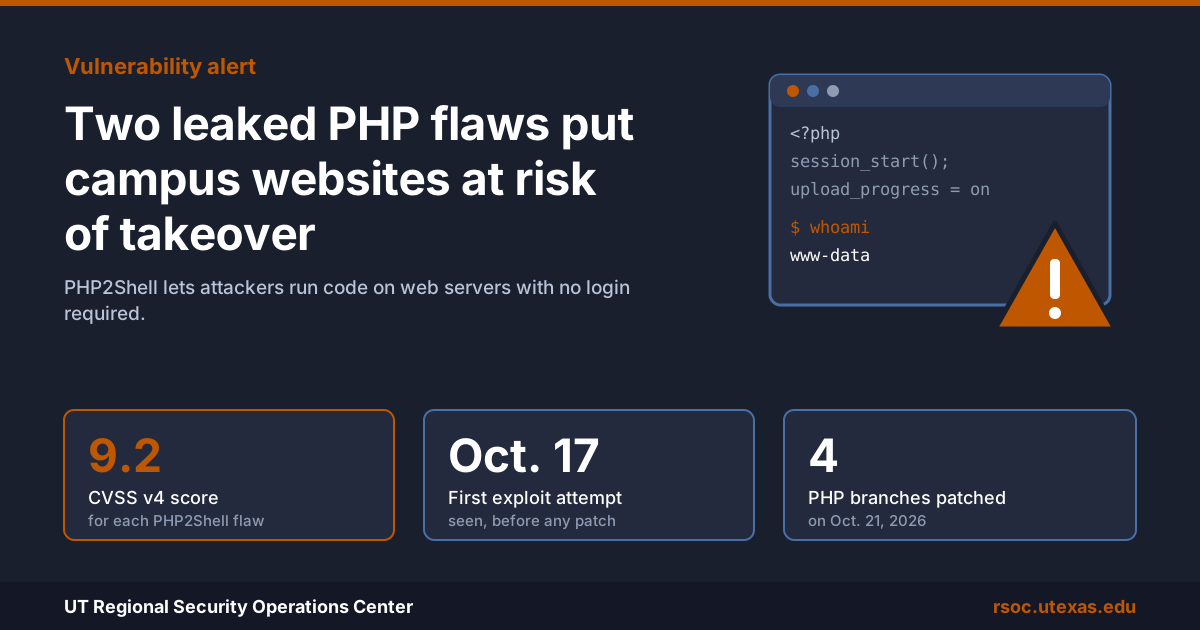
Security flaws are usually described publicly only after a fix is available. That did not happen with PHP2Shell. Technical details of two critical flaws in PHP leaked ahead of the project's scheduled security release. By the time fixes arrived on Oct. 21, attackers were already testing servers across the internet. Amazon's threat intelligence team recorded an exploitation attempt against its honeypots on Oct. 17, four days before a patch existed.
What happened
The two vulnerabilities, CVE-2026-109618 and CVE-2026-109619, are nicknamed "PHP2Shell" because they turn a PHP web server into a remote command shell. Each is rated 9.2 under CVSS version 4.0. Both allow an unauthenticated attacker to run code with the privileges of the PHP worker process, which is the same process that serves the website and usually holds its database credentials.
The flaws sit in PHP itself, not in any one application. Researchers at Wiz demonstrated unauthenticated remote code execution against WordPress, Drupal and Joomla. PHP's advisories identify Apache with mod_php as the highest-risk configuration. Public proof-of-concept exploit code appeared on GitHub within days, and security firms reported exploitation attempts at scale on the day the patches shipped.
PHP fixed the flaws in versions 8.2.35, 8.3.36, 8.4.27 and 8.5.12. For administrators who cannot update immediately, PHP published configuration changes that reduce the risk without removing it. The most important is disabling session upload progress tracking. PHP versions 5.4 through 7.3 are past end of life and will not receive fixes.
Why it matters for Texas institutions
PHP quietly runs a large share of higher education's web presence. Many Texas institutions build their main sites on Drupal or WordPress. Behind those sites sits a long tail of departmental pages, research lab sites, event registration tools, legacy student applications and vendor appliances, many of them maintained outside central IT.
This decentralization makes PHP2Shell especially dangerous. Central teams may patch the flagship site within hours while a forgotten departmental server running PHP 7.2 stays exposed indefinitely. A compromised web server can expose database credentials, single sign-on configurations and a foothold inside the campus network.
What your institution should do
Find every PHP installation. Don't stop at central web servers. Check departmental hosts, research servers, containers, virtual appliances and vendor-managed systems, and use vulnerability scans and asset inventories to fill in the gaps.
Patch supported versions and enforce mitigations where you can't. Update to a fixed release on every supported branch. Where an immediate update isn't possible, apply PHP's published mitigations, including setting session.upload_progress.enabled=0, at the server level so individual sites cannot override them.
Retire end-of-life PHP. Systems running PHP 7.3 or older will never be fixed. Migrate them, isolate them, or take them offline.
Look for signs of compromise. Exploitation often shows up as PHP worker processes launching shells or system commands, new or modified files in web directories, and unexpected outbound connections. Review web server and endpoint logs from Oct. 17 onward.
Add a protective layer. Web application firewall rules and network intrusion signatures for PHP2Shell can buy time for systems you can't patch right away. Ask your hosting providers and vendors to confirm their status in writing.
RSOC can help constituent institutions identify exposed PHP systems, review detections and investigate suspected compromise. Contact the RSOC team at RSOC@utexas.edu or visit rsoc.utexas.edu.