A researcher published a working exploit for a critical Windows Defender flaw hours after Patch Tuesday, and as of mid-June, fully updated Windows 10 and 11 machines remained vulnerable.
Imagine discovering that your smoke detector could be tricked into starting the fire it was built to catch. That is roughly what security researchers found in Windows Defender this month, when the software millions of IT administrators trust to protect their machines turned out to be a path for attackers to seize total control instead. On June 9, hours after Microsoft shipped one of its largest Patch Tuesday updates on record, an anonymous researcher released a working exploit publicly. No patch existed yet, and it worked even on machines that had just installed every available update.
What happened
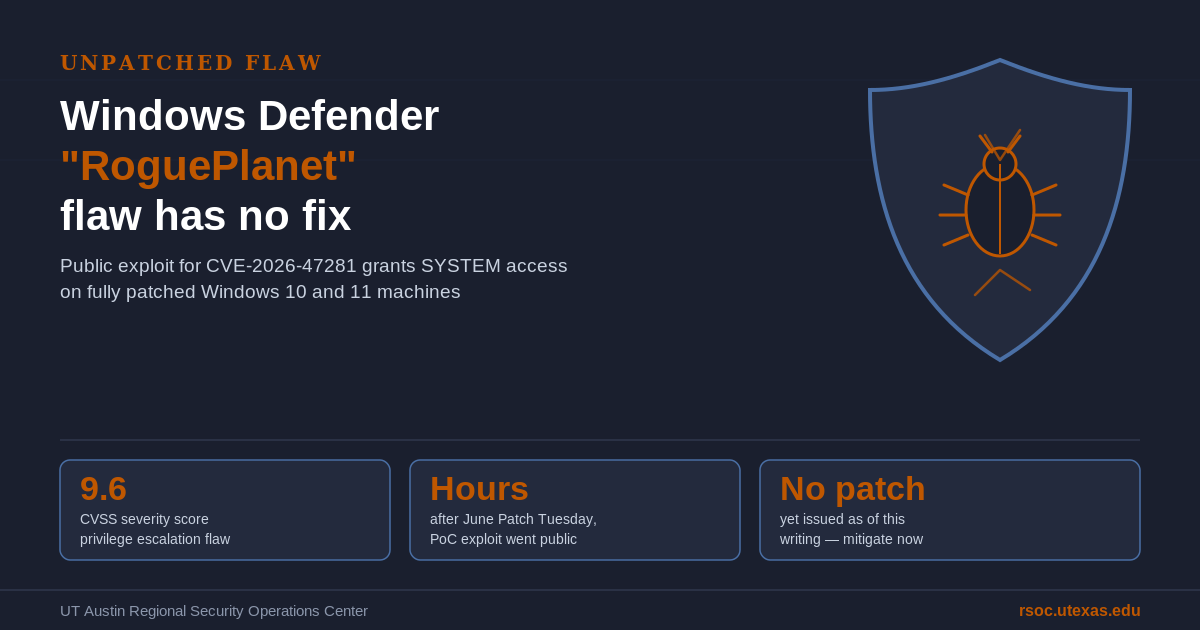
The vulnerability, tracked as CVE-2026-47281 and nicknamed "RoguePlanet," is a privilege escalation flaw rated 9.6 out of 10 in severity. It lives in how Windows Defender cleans up files it flags as suspicious. An attacker who already has some foothold on a machine, even a low-privilege one, can exploit a timing weakness in that cleanup process to trick Defender into overwriting a trusted Windows system file with malicious code. Because Defender runs with the highest level of system access, the replacement file inherits that power: full administrative control, or SYSTEM privileges, the most trusted level a Windows process can hold.
The researcher, who goes by "Nightmare Eclipse," published proof-of-concept code publicly rather than reporting it privately to Microsoft first, saying it was tested successfully on Windows 10 and 11 machines already running the June 2026 Patch Tuesday updates. The researcher called the exploit unreliable, "hit or miss," but noted a 100% success rate on some machines. This is the researcher's eighth publicly disclosed Windows exploit in three months, following a falling-out with Microsoft over how it handled earlier reports.
Microsoft has acknowledged the report and said it is investigating, while emphasizing its preference for coordinated disclosure, where researchers report flaws privately and give vendors time to build a fix first. That did not happen here. As of this writing, no official patch has shipped, meaning fully updated Windows systems remain exposed to a technique now published openly online.
Why it matters for Texas institutions
This flaw does not, by itself, let an outside attacker break in remotely. It requires the attacker to already have some access, often gained through phishing, a malicious download, or a compromised account. That is why it matters for university and agency environments: campuses are high-volume phishing targets, and once an attacker lands even limited access on a student worker's laptop or a shared lab computer, this flaw offers a fast route to full control.
For IT security teams at Texas research universities, community colleges, and state agencies, that combination, easy initial access plus a public escalation exploit, is a familiar and dangerous pattern. Systems running Windows 10 or 11 across labs, libraries, offices, and remote laptops are all potentially exposed, regardless of patch level, because no fix yet exists.
What your institution should do
Because there is no patch yet, the most effective defense is limiting what attackers can do if the exploit succeeds. IT teams should prioritize application allowlisting, which blocks unsigned or unapproved executables from running out of user-writable folders like temporary directories, since the exploit depends on getting a malicious file executed from exactly those locations. Broad rules that trust anything inside core Windows folders are not enough, since the exploit's whole purpose is sneaking a file into one of those trusted locations.
Security teams should also increase monitoring for unusual file activity tied to Windows Error Reporting and Defender's cleanup processes, the specific mechanisms this exploit abuses. Segmenting high-value systems, such as servers holding student records or research data, from general-purpose lab and office machines limits how far an attacker can move after gaining SYSTEM access on one device. Finally, watch Microsoft's channels closely for a patch addressing this flaw and apply it immediately once released, given how publicly the exploit code is now circulating.
RSOC monitors developments like this one so Texas institutions do not have to track every disclosure individually. If your team wants help assessing exposure, tuning detection rules, or interpreting Microsoft's forthcoming guidance, the Regional Security Operations Center is ready to help at rsoc.utexas.edu. When even security software can become an attack surface, a trusted partner watching alongside you matters more than ever.